How can you tell what probability is hidden behind a bookmaker's odds? We explain the simple formula, bookmaker margin and calculation examples.
Betting odds show more than just the potential payout. They can be converted into probability to understand how likely the bookmaker considers a particular outcome to be.
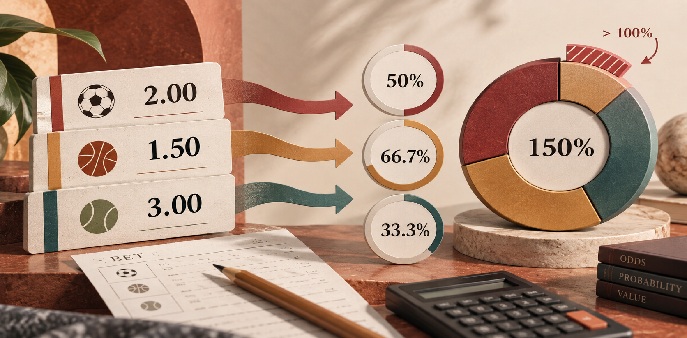
For example, odds of 2.00 correspond to a probability of 50%, while odds of 1.50 imply approximately 66.67%. However, if you convert all the odds in a single market into percentages, their total will usually exceed 100%. The reason is the bookmaker's margin.
Formula for converting odds into probability
For decimal odds, the formula is simple:
Probability (%) = 100 / odds
For example, for odds of 2.00:
100 / 2.00 = 50%
For odds of 1.50:
100 / 1.50 = 66.67%
For odds of 3.00:
100 / 3.00 = 33.33%
The lower the odds, the higher the implied probability of the outcome. Conversely, higher odds indicate that the outcome is considered less likely.
Odds-to-probability table
| Odds | Probability |
|---|---|
| 1.10 | 90.91% |
| 1.20 | 83.33% |
| 1.30 | 76.92% |
| 1.40 | 71.43% |
| 1.50 | 66.67% |
| 1.60 | 62.50% |
| 1.70 | 58.82% |
| 1.80 | 55.56% |
| 1.90 | 52.63% |
| 2.00 | 50.00% |
| 2.20 | 45.45% |
| 2.50 | 40.00% |
| 3.00 | 33.33% |
| 4.00 | 25.00% |
| 5.00 | 20.00% |
| 10.00 | 10.00% |
Why odds of 2.00 mean 50%
Imagine an event that theoretically occurs half of the time. Its probability is 50%.
To calculate the corresponding odds without a bookmaker margin, use the reverse formula:
Odds = 100 / probability (%)
So:
100 / 50 = 2.00
If an event has a probability of 25%, the fair odds are:
100 / 25 = 4.00
For an event with an 80% probability:
100 / 80 = 1.25
These are often called "fair odds". They represent the price of an outcome without the bookmaker's margin.
What is implied probability?
The probability calculated directly from betting odds is called implied probability.
For example, a bookmaker offers odds of 1.75.
100 / 1.75 = 57.14%
The implied probability of this outcome is therefore 57.14%.
It is important to understand that this is not necessarily the true probability of the event. Bookmaker odds already include a margin, so they should not be treated as a perfectly accurate estimate of the actual chances.
Why do implied probabilities add up to more than 100%?
If a market has several mutually exclusive outcomes, their true probabilities should add up to 100%.
Consider a simple two-outcome market where the bookmaker offers:
- first outcome -- odds of 1.80;
- second outcome -- odds of 2.10.
Now convert both odds into probabilities.
First outcome:
100 / 1.80 = 55.56%
Second outcome:
100 / 2.10 = 47.62%
Now add them together:
55.56% + 47.62% = 103.18%
Two mutually exclusive outcomes cannot have a combined true probability of 103.18%. The extra percentage comes from the bookmaker's margin.
How to calculate a bookmaker's margin
For a simple market, an approximate indication of the margin built into the odds can be found by measuring how far the total implied probability exceeds 100%.
In our example:
103.18% - 100% = 3.18%
The resulting 3.18% is the market overround -- the amount by which the total implied probabilities exceed 100%.
The higher the overround, the more the bookmaker has reduced the offered odds compared with their fair values.
Another example of bookmaker margin
Suppose a bookmaker offers identical odds of 1.90 on two opposite outcomes.
The implied probability of each outcome is:
100 / 1.90 = 52.63%
Total:
52.63% + 52.63% = 105.26%
Overround:
105.26% - 100% = 5.26%
Without a margin, two genuinely equally likely outcomes would have fair odds of 2.00 and 2.00. By offering 1.90 and 1.90 instead, the bookmaker builds an advantage into the market.
How to remove the margin from betting odds
If you want to estimate outcome probabilities without the bookmaker's margin, the implied probabilities can be normalized.
Let's return to the example with odds of 1.80 and 2.10:
- 1.80 = 55.56%;
- 2.10 = 47.62%;
- total = 103.18%.
Now divide each probability by the total.
First outcome:
55.56 / 103.18 × 100 ≈ 53.85%
Second outcome:
47.62 / 103.18 × 100 ≈ 46.15%
Now:
53.85% + 46.15% = 100%
This gives an approximate estimate of the probabilities after removing the bookmaker's margin.
How to convert probability into odds
You can also perform the calculation in reverse. If you already have your own estimate of an event's probability, it can easily be converted into decimal odds:
Odds = 100 / probability (%)
For example:
- 70% probability -- odds of 1.43;
- 60% probability -- odds of 1.67;
- 50% probability -- odds of 2.00;
- 40% probability -- odds of 2.50;
- 25% probability -- odds of 4.00;
- 10% probability -- odds of 10.00.
This calculation is particularly useful when comparing your own probability estimate with the odds offered by a bookmaker.
How probability relates to betting value
High or low odds alone do not tell you whether a bet offers value. The key is to compare the odds with the actual probability of the outcome.
Suppose a bookmaker offers odds of 2.00. These correspond to an implied probability of 50%.
If you estimate that the event will occur only 45% of the time, odds of 2.00 are not high enough relative to the risk.
If, however, you estimate the true probability at 55%, the situation changes. For a probability of 55%, the fair odds are:
100 / 55 = 1.82
The bookmaker is offering 2.00. In other words, the available odds are higher than the calculated fair odds.
This type of discrepancy is the basis of value betting: bettors look for situations where the price offered by the bookmaker is higher than their own estimate of the fair odds.
Odds are not a prediction
One common mistake is to treat betting odds as an exact prediction of probability.
If a bookmaker offers odds of 2.00, this does not necessarily mean that the event has a true probability of exactly 50%.
Odds are influenced by:
- the bookmaker's assessment of the event's probability;
- the bookmaker's margin;
- changes in circumstances before the event;
- betting line movement;
- the amount of money wagered on different outcomes;
- the characteristics of the particular market.
Converting odds into probability is therefore primarily a way to understand what probability is reflected in the current price.
Example of a three-way market
The same principle applies to a football 1X2 market, where the possible outcomes are a home win, a draw or an away win.
Suppose the bookmaker offers:
- Home win (1) -- 2.00;
- Draw (X) -- 3.50;
- Away win (2) -- 4.00.
Convert the odds into probabilities:
- Home win: 100 / 2.00 = 50%;
- Draw: 100 / 3.50 = 28.57%;
- Away win: 100 / 4.00 = 25%.
Total:
50% + 28.57% + 25% = 103.57%
The amount above 100% is 3.57%. This represents the overround built into this set of odds.
Why convert betting odds into percentages?
Probabilities are often easier to understand than odds. The phrase "odds of 1.43" does not immediately tell everyone how likely an event is, while a probability of around 70% is much easier to interpret.
Converting odds into percentages helps you:
- quickly estimate how likely an outcome is considered to be;
- compare different odds;
- identify the bookmaker's margin;
- compare your own probability estimate with the bookmaker's market;
- find potential value bets;
- better understand odds movements.
Conclusion
Converting betting odds into probability is simple: divide 100 by the decimal odds. Odds of 2.00 correspond to 50%, 1.50 to 66.67%, 2.50 to 40%, and 4.00 to 25%.
However, bookmaker odds include a margin. As a result, the sum of the implied probabilities for all outcomes in a market will usually exceed 100%. By removing this excess and normalizing the values, you can obtain a more useful estimate of the probabilities without the bookmaker's margin.
Understanding this relationship allows you to see betting odds not simply as a potential payout, but as a representation of the probability built into the bookmaker's market.