```html
Introduction: What is the Martingale Strategy
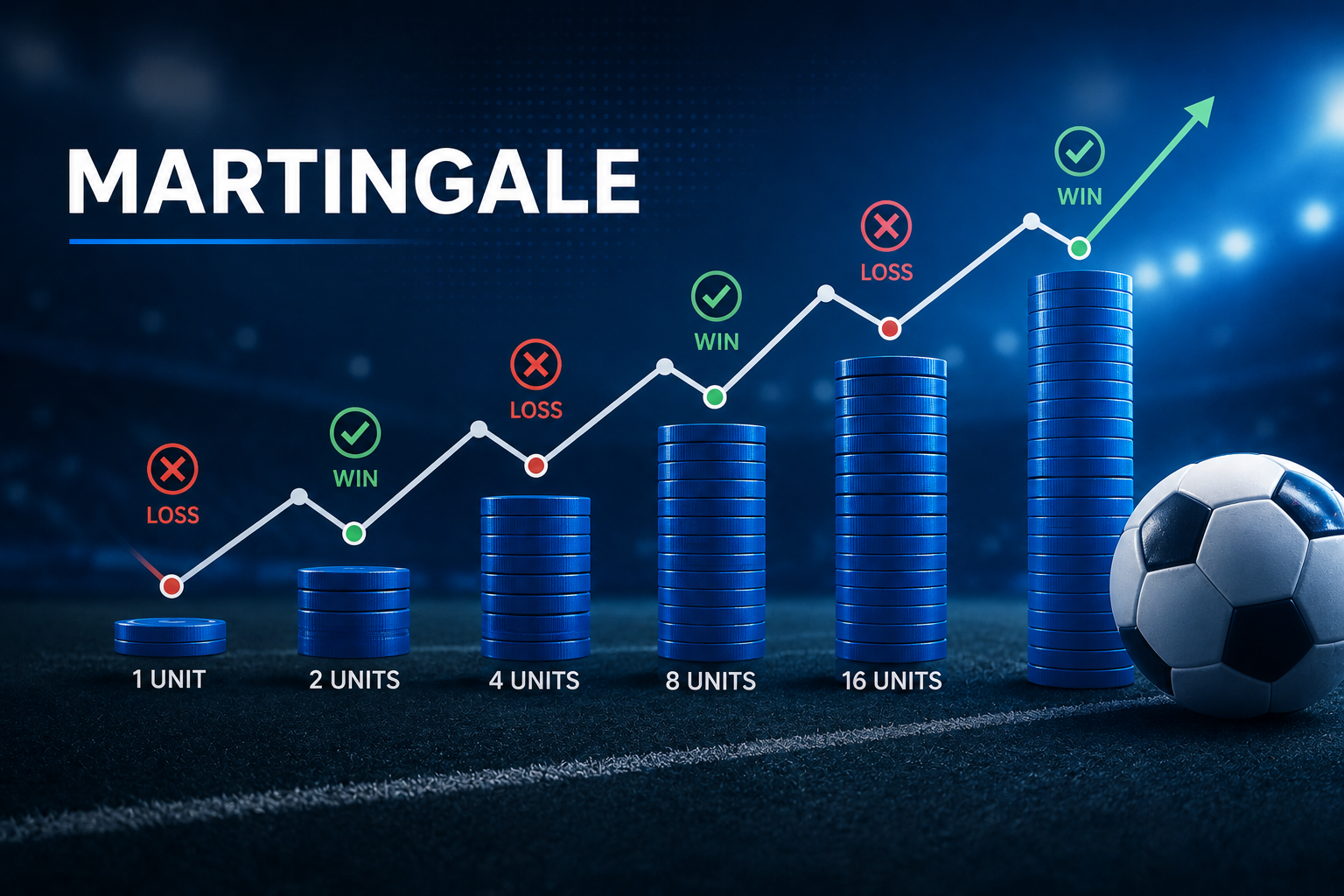
The Martingale strategy, also known among gamblers as "chasing losses," is a betting management system where the size of the next bet increases after a loss. The main idea is for one win to cover all previous losses and bring a small profit.
This method entered the world of sports betting from casinos, where it has been applied for decades in games with roughly equal odds—roulette, craps, card games. In sports betting, the strategy has adapted and gained its own features related to the variability of odds and the specifics of sports events.
In this overview, we will examine how the Martingale system works, its strengths and weaknesses, and under what conditions it can be practically applied.
1. How the System Works
1.1. Basic Principle
The essence of the Martingale strategy is extremely simple. The player chooses an event with odds no lower than 2.00 and places a bet. If the bet loses, the next one is increased so that in case of a win, it covers all previous losses and results in a fixed profit.
For odds of 2.00, the formula is straightforward—the next bet is double the previous one. For other odds, the calculation is done using the formula:
**Next Bet Size = (Sum of Lost Funds + Target Profit) / (Odds - 1)**
In practice, this means that the higher the odds, the slower the bets grow after losses, and conversely—low odds require aggressive increases.
1.2. Example of Strategy in Action
Let's consider a classic situation with odds of 2.00. The player starts with 10 units.
| Step | Bet (units) | Odds | Result | Payout (units) | Total balance (units) |
|---|---|---|---|---|---|
| 1 | 10 | 2.00 | Loss | 0 | -10 |
| 2 | 20 | 2.00 | Loss | 0 | -30 |
| 3 | 40 | 2.00 | Loss | 0 | -70 |
| 4 | 80 | 2.00 | Win | 160 | +10 |
Note: after winning on the fourth step, the player recovers all previous losses (70 units) and makes a net profit equal to the initial bet (10 units). The cycle is complete.
1.3. Variants of the Strategy
Over time, several modifications of the classic Martingale have appeared, each solving specific tasks.
**Classic Martingale** involves doubling after each loss and returning to the initial bet after a win. It's the simplest and most straightforward version.
**Soft Chasing** uses an increase by a fixed percentage or a certain multiplier less than two instead of doubling. Bets grow more slowly, but more consecutive wins are required to recover.
**Long-term Chasing** does not return to the initial bet after each win but continues the cycle until a certain goal is achieved. This variant requires more complex calculations.
**Reverse Martingale** is the opposite strategy, where the bet increases after a win and decreases after a loss. This method focuses on exploiting winning streaks.
2. Potential Advantages
2.1. Ease of Use
One of the main advantages of the Martingale strategy is its exceptional simplicity. No deep analysis of sports events, understanding of tactical schemes, or study of statistics is needed for its application. Simply choose an event with a suitable odds and follow the algorithm.
This makes the strategy accessible to beginners who are just starting to get acquainted with betting and are not ready to spend time on complex analytical methods.
2.2. Psychological Comfort
Paradoxically, the Martingale strategy can provide a certain psychological comfort. The player already knows what the next bet will be and understands that one win can close a series of losses. The absence of the need to make decisions during the series reduces stress levels and emotional burden.
Moreover, frequent small wins create positive reinforcement. The player regularly records profits, which supports confidence in their actions.
2.3. Effectiveness in Short Distances
In short-term play with a small number of cycles, the strategy shows good results. The probability of encountering a long series of losses in a short distance is small, allowing the player to achieve several profitable cycles in a row.
For those who use the strategy episodically rather than daily, Martingale can be a workable scheme for securing small profits.
2.4. Possibility of Combining with Analysis
Some players combine Martingale with their own predictions. Instead of betting on all events, they select events they are confident in and apply chasing only to them. This reduces the probability of long series of losses and increases the overall effectiveness of the strategy.
This approach requires more time and skills but allows utilizing the strengths of Martingale—systematic and discipline—without its main drawbacks.
3. Limitations and Risks
3.1. The Problem of Long Losing Streaks
The main risk of the Martingale strategy is the possibility of encountering a long losing streak, which leads to a catastrophic increase in bets.
Even with odds of 2.00 and a theoretical 50% probability of winning, a series of ten consecutive losses has a probability of about 0.1%. This means that roughly one in a thousand such series can be expected. With active play, such a situation will inevitably occur.
What does this mean in practice? With an initial bet of 10 units, after ten losses, the player will need to bet more than 10,000 units. The total loss by this point will exceed 20,000 units. Not every player has a bankroll of this size.
3.2. Limitations of Betting Companies
In practice, the player faces not only mathematical but also technical limitations. All betting companies set maximum limits on bets. For popular events, the limit may be several thousand units, but for less popular ones, it can be significantly lower.
If during chasing, the required bet size exceeds the maximum permissible limit of the bookmaker, the strategy will be interrupted, and the player will not be able to recover previous losses. This makes some losing series fatal regardless of the bankroll size.
Moreover, many betting companies monitor players using aggressive betting management strategies and may restrict their accounts or individually lower the maximum limits.
3.3. Bankroll Size Requirements
For the safe use of Martingale, a very large gambling bankroll is required. Experienced players recommend having a reserve for at least 10-15 chasing steps. With an initial bet of 10 units, 15 steps would require a bankroll of about 163,830 units—the risk-to-potential-profit ratio is more than 16,000 to 1.
In fact, the player risks a huge amount for a very modest profit. From a financial point of view, this is an inefficient use of capital.
3.4. Bookmaker's Margin
There is a common misconception that Martingale allows "cheating" the mathematics of betting. In reality, the strategy does not eliminate the bookmaker's advantage embedded in the margin.
Even with odds of 2.00, the actual probability of an event rarely equals exactly 50%. Due to the bookmaker's margin, the true probability may be 48.5% or even less. This means that the expected value of each bet is negative, and in the long run, the player will lose money regardless of the betting management strategy used.
Martingale only redistributes losses over time, making them less frequent but larger, but does not change the final negative expected value.
4. Practical Recommendations
4.1. Choosing Odds
For the Martingale strategy, odds in the range of 2.00 to 3.00 are considered optimal. At lower odds, bets grow too quickly, increasing the risk. At higher odds, the probability of losing significantly increases, making long series more likely.
Practice shows that the most balanced range is 2.00-2.50. In this range, the growth of bets remains manageable, and the probability of winning stays at an acceptable level.
4.2. Bankroll Management
Even when using Martingale, basic bankroll management principles must be followed. The initial bet should not exceed 0.5-1% of the total gambling bankroll. With this approach, even a long series of losses will not lead to complete bankruptcy.
It is also recommended to set a limit on the maximum number of steps in one series. For example, if a player decides not to make more than seven steps, they can stop in time and fix losses without trying to recover at any cost. Fixing a loss is an important skill that distinguishes a disciplined player from a reckless one.
4.3. Choosing Events
Not all events are equally suitable for chasing. The most preferred are sports and markets where:
- odds are sufficiently stable and predictable
- events occur regularly, allowing cycles to be completed in a reasonable time
- there is statistical justification for selecting bets
Some players specialize in chasing draws in football or totals, others prefer tennis or basketball. There is no single recipe here, and each player eventually finds the most comfortable markets for themselves.
4.4. Combined Approaches
A more advanced option for using Martingale is to combine it with other betting strategies. For example, a player may use value betting to choose events with overestimated odds and apply Martingale only for managing bet sizes.
This approach is much more complex than the classic chase and requires a good understanding of probability theory and the principles of operation of betting companies. But it is this approach that allows, if not overcoming, then minimizing the impact of the bookmaker's margin.
5. Alternative Betting Management Strategies
For the sake of objectivity, it is worth mentioning that Martingale is not the only betting management system. There are alternatives with different risk and potential return ratios.
5.1. Kelly Criterion
The Kelly Criterion is a mathematically based method for calculating the optimal bet size. The formula takes into account the probability of winning and the offered odds, selecting the bet size that maximizes bankroll growth in the long run.
This method is more complex than Martingale and requires the ability to assess the actual probability of events. However, when used correctly, it provides the best theoretical capital growth.
5.2. Fixed Percentage
The simplest method of bankroll management is a fixed percentage bet of the current bankroll size (usually 1-5%). With this approach, losses automatically reduce the size of the following bets, which naturally limits risk.
This method does not offer quick ways to recover after losses, but it practically eliminates the possibility of complete bankruptcy. It is widely recommended by professional players as the foundation of disciplined play.
5.3. Flat Betting
The most conservative approach is betting the same amount regardless of the results of previous bets. This method does not allow for rapid bankroll growth, but it also does not create a risk of catastrophic losses.
For beginners, this is often the most sensible choice, as it allows them to focus on the quality of their predictions rather than on betting management.
Conclusion
The Martingale strategy in sports betting is a tool, like any other tool. It has its strengths: simplicity, clarity, psychological comfort from having a clear algorithm. It also has weaknesses: demands on bankroll size, vulnerability to long losing streaks, restrictions from bookmakers.
This strategy does not make a player a winner in the long run, as it does not eliminate the main obstacle—the bookmaker's margin. However, in the short term and with proper risk management, it can be part of a betting strategy.
The main conclusion to be drawn from familiarity with Martingale is the following: no betting management strategy turns bad predictions into good ones. The quality of event selection is always more important than the method of bet distribution. A player who understands sports well and finds valuable odds can be successful even with the simplest bankroll management system. A player who relies solely on Martingale will sooner or later face its mathematical limitations.
As in any area of betting, the key to long-term success is discipline, risk management, and a realistic understanding of one's capabilities.
```